


Samuel Coleridge-Taylor and the Croydon music scene
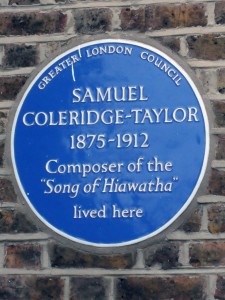
, used under .
(), Croydon’s famous African-British composer, was taught music as a child and young teenager by his grandfather Benjamin Holmans, his headmaster at the Croydon British Boys’ School, Herbert Walters, by the choir master at St George’s Presbyterian church, and by Joseph Beckwith, a local violin teacher.
This was a period of mass public musical and theatrical entertainment, the widespread use of performed music in organisations’ events, and of playing music in the home. In such a world, while the young man was a student at the Royal College of Music, his published compositions found a ready audience. Then with the success of his he found himself in demand around Britain.
But the central core of his activities was in Croydon and surrounding districts of south London and Surrey. Music permeated organised community and social life, and for fund raising for local charities and hospitals. There are numerous examples such as the Croydon Industrial Co-operative and Croydon Socratic Societies, Upper Norwood Literary and Scientific Society and Leslie United Football Club. He taught at Croydon Conservatoire of Music and Art, conducted local musicians in groups like Croydon String Players Club, the Croydon Orchestral Society, and was President of the Addiscombe Choral Union. He treated his audiences to a wide range of music in the classical genre and by contemporary composers.
The String Players Club included the three Petherick sisters, the two l’Anson sisters (both on violin), Henry Down and his wife and Gertrude Fawcett (also on violin). Under Coleridge-Taylor’s direction it quickly “reached a very high level in its performances, and for a long time remained the chief musical influence in Croydon”.
Coleridge-Taylor was not the only local conductor-composer. His friend from college days, William Hurlstone, also lived in Selhurst. Before college he had been taught the piano by Arthur Wilmot, principal of Croydon Conservatoire. His Century Concerts promoting chamber music, especially wind instruments, “helped to raise the standard of music in Croydon, giving a much needed impetus”. Hurlstone was conductor of Anerley Choral Society, Addiscombe String Orchestra, and Director of Norwood Operatic Society. He taught at Croydon Conservatoire, and was accompanist to the local Bach Choir before dying young in 1906.
Other local music groups included the Excelsior Musical Society, Addiscombe Philharmonic Society, Purley Choral Society, and the Norwood Free Lancers. Also part of the network of well-off enthusiasts who underpinned Croydon’s musical life at this time were William Stanley, who founded Norwood’s , and Alexander Beaumont, who sponsored the halls’ grand opening in October 1906. The opening night programme included works of his own as well as music by Coleridge-Taylor and Hurlstone. The String Players Club performed.
It might surprise modern readers to learn how many women were actively involved at the heart of musical life in Croydon in Coleridge-Taylor’s time. Local music teachers like Miss Amy Inglis, and Miss Stallard, who was described as “one of the institutions of Croydon” also put on concerts, the latter including performances by Hurlstone. Walters and his wife organised one for Croydon Volunteers Institution and Hurlstone’s sister Katie was another of the many local amateurs.
Coleridge-Taylor conducted the all female local Bach Choir. The daughters of Addiscombe’s Horace and Clementia Petherick played the violin, viola and cello. Their father was an authority on the violin, and Leila Petherick became a teacher of voice production and singing as well as of violin and viola. Marion Louise Lawrence, an African American who had been a member of the Fisk Jubilee Singers in the 1880s, married Henry Thrift of the wholesale provisions family in Croydon in October 1890. When she died in 1907, living on Park Lane, her obituary stated that she and Henry “placed their musical talents at the disposal of charitable objects and the enjoyment of their many friends”. She knew the Coleridge-Taylors well.
Another interlinked part of the network were the supporters like Beaumont of the Royal Normal College and Academy of Music for the Blind in Upper Norwood which provided education for children from all over Britain and its colonies. One of its pupils, James Augustus Alves from Berbice, went on to open the Institute for the Blind in Trinidad in May 1914.
When Coleridge-Taylor’s funeral service was held at St Michael and All Angels’ Church in Poplar Walk there was a very large number of attendees, including members of Croydon Stagers Operatic Society, and many floral tributes to a man whose commitment to the local music world left a legacy which endures to this day. To construct the full history of that world still requires significant research. I hope that this article may stimulate others to join in.

